Showing posts with label good. Show all posts

Thursday, June 5, 2014

Mamoru Fujieda- Patterns of Plants (1997)


Apparently if plants could speak they would talk in brief phrases that meander and loop over and over and over, only slightly varying with each iteration, yet still conveying great depth: showing that the seeming randomness of our electricity causally links us to nature, to the chill of air that hits you after rounding a corner, or the whirling path those helicopter seeds take after launching from their pods to the ground below, or the chirping crickets that won't shut the fuck up on a summer night yet still create a lulling drone that canvases an entire forest, as if blanketing your ears for protection from damning silence, from silence that, when present, makes you turn inward, chewing on your own thoughts to fill the void with some chatter all at the expense of your own sanity, which is merely the result of sparks running through your head in a certain fashion, the same sparks that reach out into air and feel that wind chill or process that image of the seed spinning, spinning, around and around, meandering through the air before abruptly coming to a halt, in the style of those plants, whose language floats about in a circle, both going nowhere but still saying so much in the process.

link

Friday, December 27, 2013

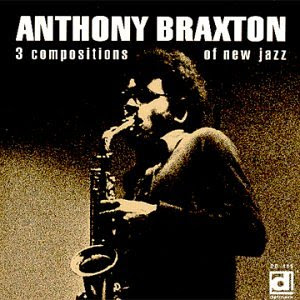
Anthony Braxton- 3 Compositions of New Jazz [1968]


A friend of mine once astutely noted that Anthony Braxton was the Modern Classical equivalent of the jazz world (which would make Art Tatum the Classical Era equivalent, if you enjoy extending analogies too far).  Graphical notation and a penchant for unique instrumental combinations that lead to slanted, atonal eddies of sound adequately sums up most of Braxton’s career, although such a superficial description is a disservice to the iconoclast.  His first release before the solo improvisational For Alto, 3 Compositions of New Jazz finds Braxton arriving at the logical conclusion of the then blossoming free jazz movement.  Ditching the archetypal rhythm section for the occasional expressionist drumming and atmospheric accoutrements, Braxton and his fellow musicians create a complex web of conversation amongst one another.  The indecipherably named first track revolves around the lovely vocal melody laid out at the beginning of the record, yet quickly spirals into a display of raw instrumentation and interplay.  Braxton’s music is as free as free jazz can get, yet still possesses the mathematical intricacy of the Modern Classical music he often cited as influence.  But don’t be misled: Braxton’s jazz is still visceral and mysterious in its outré display of emotion.  Much like his cryptic composition names, this music possesses depth that reveals itself only after intense scrutiny, and even then still might come off as obtuse.  A must-listen for anyone who is a fan of boldly unique music. 


LA LEEE LAAA LALALAAAA